Erosion Protection of Compressor and Steam Turbine Blades with HVAF and HVOF
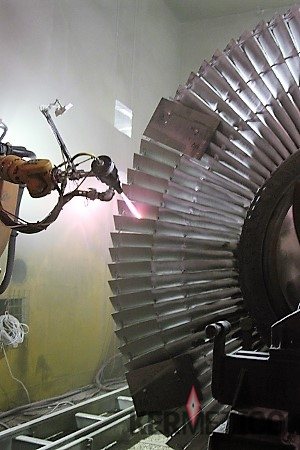
Kermetico HVAF technology and equipment allow the deposition of impermeable, hard and ductile coatings to protect steam turbine blades from water droplet erosion.
The high hardness and high ductility of our bulk-like coatings reduce the erosion rate substantially and provide loading stress resistance, while the gas-tight structure provides corrosion resistance.
Kermetico air-cooled equipment is easy to transport and use on-site both in robotic and handheld operation.
Our coatings provide a better quality/price ratio for steam turbine blades protection than most other coatings, heat treatment or implantation methods.
The Erosion of Turbine and Compressor Blades
Water Droplet Erosion of Steam Turbine Blades
Water droplet erosion of steam turbines happens due to the impingement of water droplets of several hundred microns to a few millimeters size at velocities of hundreds of meters per second on the edges and surfaces of low-pressure steam turbine blades.
The Liquid Impingement Erosion of Compressor Blades
In the power generation industry, inlet fog cooling is used frequently to cool down the turbine intake air. Gas turbine inlet air fog cooling is the most direct, cost-effective, and energy-efficient solution for increasing the power output of gas turbines. It is performed by spraying water into the gas turbine inlet.
This approach results in liquid impingement erosion of the rotating blades in the compressor, performance degradation and service life reduction of gas turbines. Liquid impingement erosion is defined as the continuous material loss from a solid surface due to the repeated impacts of liquid drops or jets.
The solution to these problems is in high demand especially due to the high replacement cost of the blades of gas turbines’ compressors and those operating at the low-pressure (LP) end of steam turbines.
Surface engineering substantially improves erosion resistance of turbine and compressor blades. There are a variety of protection methods, including heat treatment, hard-facing, laser cladding and thermal spraying. HVOF tungsten carbide, chromium carbide and Stellite-type coatings have been chosen among the best thermal spray candidates, while laser cladding of a Stellite-type coating has been a winning metallurgical approach.
The Advantages and Disadvantages of Different Surface Engineering Methods for Mitigating Water Droplet Erosion
| Method | Water Droplet Resistance | Technological Risk | Necessity of Post-Treatment | Cost |
| Heat treatment | Lowest | Part Geometry Distortion | No | Lowest |
| Laser Clad Stellite | Moderate | Part Geometry Distortion | Yes | Highest |
| HVOF Stellite | Moderate | No | No | High |
| HVOF Cemented Carbides | High | Cracking | No | High |
| HVAF Tungsten Carbide | Highest | No | No | Moderate |
Recent developments in HVAF technology have made Ultra-quality Kermetico HVAF WCCoCr coatings the best choice to resist water droplet erosion.
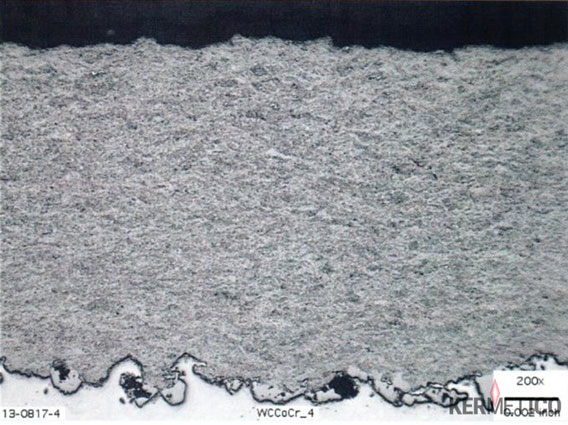
A Micrograph of a HVAF C6 System in U-mode Using Propylene Gas to Spray a Tungsten Carbide Coating: No Gas Permeability at 300 PSI, Hardness 1,650 HV300