Metal Spraying of Capacitor Ends
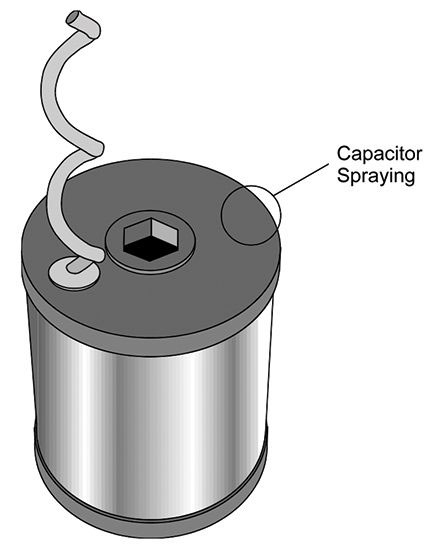
One of the very common applications that has been undertaken for over 4 decades is the spraying of capacitor ends. In the manufacture of thin film capacitors, the end faces are commonly sprayed with zinc or tin/zinc alloys. The purpose of the coating is to connect the layers of the metallic foils together and also to give a sturdy, robust layer to make soldered wire connections to the capacitors. Coatings are often several hundred microns thick. One of the main benefits of the thermal sprayed coatings are that only small amounts of heat are transferred to the capacitors, meaning there is no damage to the plastic film part. Capacitors of varying sizes are commonly sprayed, from small lighting capacitors up to large, power capacitors.
Reason for use: Electrical conductivity
The most common type of capacitor in use today is the foil-wound type. A thin film of metal, 1µm, is deposited on one side of a thin, 2.5 – 14µm, polymer film di-electric leaving one edge un-coated.
The film is wound around a central insulating core to form a ‘swiss roll’ with the un-coated edges staggered to permit the ends to be joined. The ends of the roll are then sprayed with metal to link up the electrodes and provide a surface for attaching the terminals. Larger, specialist capacitors are also sprayed.
Equipment: Metallisation Arc Spray Systems
Materials: Zinc wire, Tin/Zinc 60/40 wire.
Many metals may be sprayed on to the ends of capacitors; copper, brass, aluminium, zinc and tin- zinc alloys have been employed. Modern practice favours zinc and tin-zinc, since these materials cause less damage to the capacitor, provide a better surface for attaching and give more consistent results. The sprayed deposits may be either combustion flame sprayed or electric arc sprayed but arc sprayed coatings are most commonly used. Because arc sprayed zinc and tin- zinc give cooler deposits there is less damage to capacitors and the product is more consistent. Arc spraying also offers considerable production engineering and economic benefits.
Manufacture of Capacitors
The rolled capacitors are mounted in a jig. Masking is accomplished either by an extra film winding, which is removed before boxing or encapsulation of the capacitor, or by flattening the capacitors and packing them tightly into the spraying jig. For small quantity production, jigs may be hand sprayed or hand fed to a pistol on a fixed mounting, but, where large quantities (several hundred thousand – several million/week) are required, fully automated plant where both pistol and jig are moved to give a controlled x-y traverse may be supplied. The pistol is usually directed either normal to the capacitor end or up to 15º from the normal. The sprayed coating thickness is determined by the winding quality and is usually 0.014″-0.016″ (350µm – 400µm) but for some high class thin film capacitors, coatings may be thinner 0.010″-0.012″ (250µm – 300µm). The choice of coating depends on the joining technique; usually the coating is mainly zinc with the final 0.003″- 0.004″ (75µm – 100µm) being tin-zinc to provide a readily solderable surface. Some applications will just apply only zinc or only tin-zinc to simplify the application process.
It is preferable that metal spraying takes place after heat stabilisation, since this and the consequent shrinkage could cause a previously sprayed end connection to break up. Terminals are usually attached by soldering but in some cases micro-welding techniques may be employed.
*Excessive air pressure and spraying ranges will result in serious metal losses. It is usual to experiment with these parameters to determine the minimum values, which will give satisfactory deposits.
Advantages of Arc Spraying
- Reduced spraying ranges and higher particle velocities give better penetration of the foil windings.
- The lower heat input to the capacitors gives more consistent products.
- Arc spraying is inherently more consistent in operation.
- Arc spray coatings are denser and contain less oxide.
- The lower heat input to the capacitors gives reduced scrap rates.
- Arc spraying equipment is easily automated.
- Electrical energy costs are cheaper than fuel gas/oxygen.
- No energy is consumed when not spraying.
- Stop-Start operation is easier.
- Electrical supplies are generally more readily available.
- Potentially flammable and explosive gases are not required.